Blog
Deck Cleaning and Staining in DFW: What Makes Wood Decks Different From Fences — and How to Protect Both
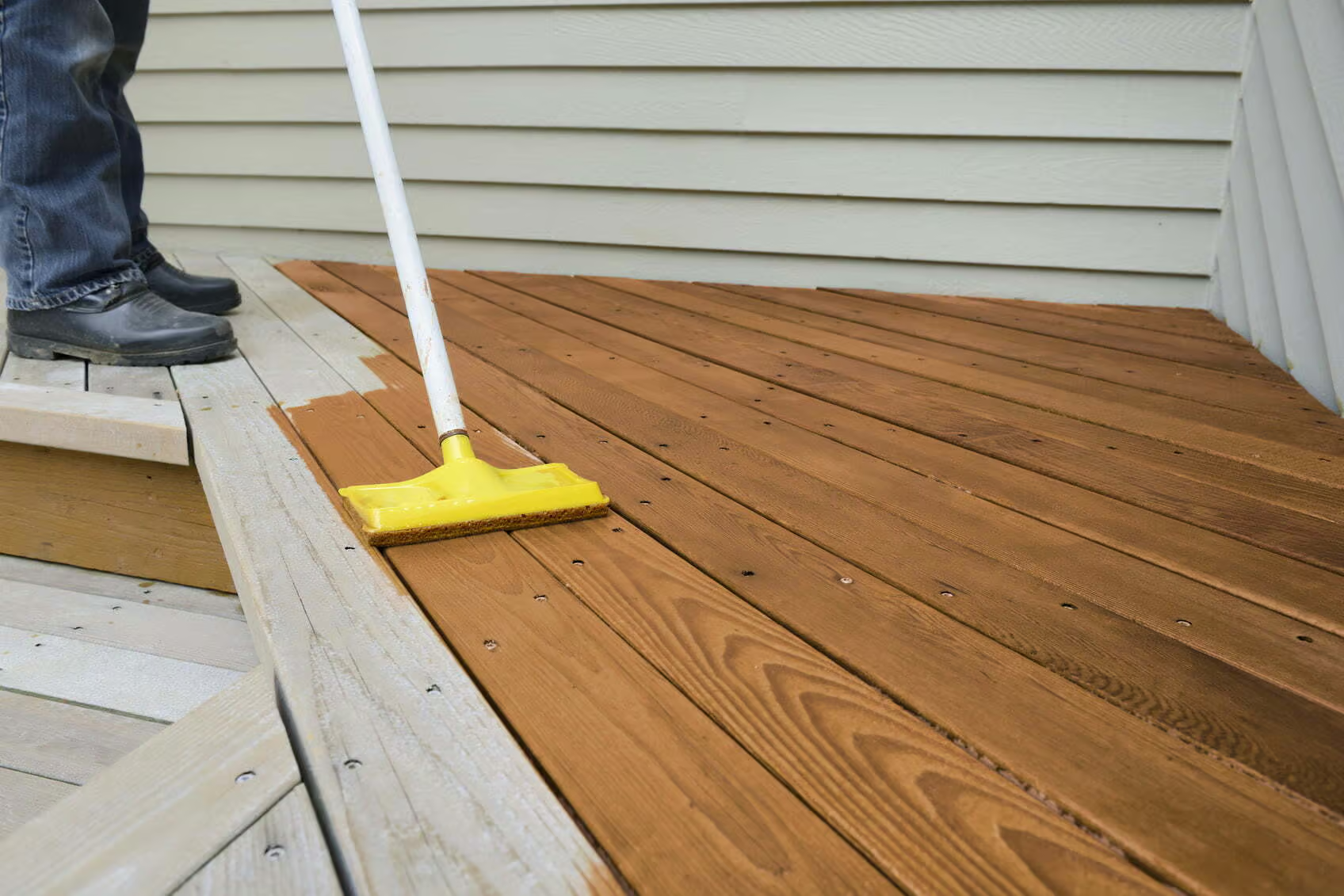
DFW homeowners who have both a wood deck and a wood fence often assume the maintenance is interchangeable — the same cleaning, the same product, the same schedule. The logic seems reasonable: both are exterior wood, both need staining, both are in the same climate. The reality is that decks and fences face significantly different exposure conditions in North Texas and need specific adjustments in how they're prepared, treated, and maintained.
Understanding what makes deck maintenance distinct from fence maintenance — and how professional cleaning and staining addresses each surface correctly — produces better results for both investments than applying a single approach to everything.
Why Decks Face More Demanding Conditions Than Fences
The fundamental difference between a wood deck and a wood fence is orientation — and that difference drives everything about how each surface interacts with DFW's climate.
Horizontal surfaces absorb and hold moisture: Fence boards are vertical. Rain that hits a fence board runs down its face and off the bottom edge. The contact time between water and wood is brief, and the board dries relatively quickly. Deck boards are horizontal. Rain falls directly onto the top face and stays there — the water sits in contact with the wood until it evaporates or drains through gaps between boards.
In DFW's spring rain season, this means deck boards may stay wet for hours after each rain event. Over an active spring with multiple rain events per week, deck boards experience significantly more cumulative moisture contact than fence boards in the same location. This elevated moisture exposure accelerates the wet-dry cycling stress that produces surface checking and splitting — the failure pattern that appears on deck boards faster than on fence boards under the same conditions.
Direct UV impact from above: Fence boards receive angled UV — the sun hits the fence face at varying angles throughout the day depending on the board's orientation, and only south and west-facing sections receive direct intense afternoon sun. Deck boards receive direct UV impact from overhead — the same overhead UV that makes DFW summers brutal falls directly on horizontal deck surfaces throughout the peak UV hours of every summer day.
This overhead UV impact is more intense per square foot of wood surface than the angled UV hitting most fence sections. Deck boards deplete their stain protection faster than fence boards receiving equivalent angled exposure for this reason.
Foot traffic and mechanical wear: Fence boards are never walked on. Deck boards carry the full foot traffic of outdoor living — barefoot summer use, furniture movement, entertaining activity, and the mechanical abrasion that human activity creates. This foot traffic adds a physical wear mechanism to UV and moisture that fence staining never faces.
The combination of higher moisture exposure, more intense UV, and mechanical wear means deck stain depletes faster than fence stain under comparable application — often 12 to 18 months for heavily used decks compared to 24 to 36 months for fences in similar conditions.
What's the Same: The Core Staining Principles Still Apply
Despite the different exposure conditions, the core principles that make fence staining effective in DFW apply equally to deck staining.
Oil-based penetrating stain is the right product for both surfaces. The penetrating mechanism — stain entering wood fiber rather than forming a surface film — is what allows the stain to flex with the wood as it expands and contracts through DFW's seasonal cycle rather than cracking and peeling. This mechanism is even more important on deck surfaces that face the more extreme dimensional movement of horizontal wood than it is on fence boards.
Thorough preparation before staining — professional pressure washing with biocidal pre-treatment, adequate drying time, moisture verification — is equally non-negotiable for decks as for fences. Stain applied over contaminated or wet deck boards fails for the same reasons it fails on contaminated or wet fence boards.
The water bead test is equally valid for assessing deck stain condition as fence stain condition. Water applied to deck board surfaces that soaks in immediately rather than beading indicates depleted protection — the same indicator that drives fence restaining decisions.
Deck-Specific Preparation: What's Different
While the core principles are the same, several prep considerations are specific to deck surfaces or require adjustment from standard fence washing approach.
Pressure settings for deck boards: The wood species and condition of deck boards affects appropriate pressure settings. Standard cedar fence boards and standard deck lumber are similar in density, but decks sometimes use softer wood species that require lower pressure than the settings appropriate for cedar fence boards. Redwood and pressure-treated pine — both common deck materials — have surface characteristics that benefit from more conservative pressure settings than cedar fence boards.
Deck boards that have been through multiple seasons of DFW weather without treatment may have surface checking that conservative pressure settings avoid widening. Pressure washing that runs along the grain at appropriate settings produces effective cleaning without mechanically widening existing checks that more aggressive settings would exacerbate.
Between-board gaps: Deck construction creates gaps between boards — either intentional spacing for drainage or the natural movement gaps that develop as boards dry. These gaps accumulate organic debris — leaves, seed pods, dirt — that holds moisture against the board edges and creates biological growth concentrated at the board sides rather than the faces. Pressure washing that specifically addresses between-board gaps and board edges, not just the top faces, removes this accumulated debris and treats the growth that develops in these moisture-accumulating locations.
Structural connection points: Deck boards attach to the joist structure below them through fastener penetrations — screws or nails that go through the board face into the joist. These fastener penetrations are moisture entry points on deck boards that fence boards — which attach to rails at their back face — don't have on their top surface. Cleaning and staining that specifically addresses fastener point areas on deck boards treats the highest-risk moisture entry locations on the deck surface.
Stair treads and railings: Deck stairs create specific maintenance considerations because tread boards face the same horizontal exposure as deck field boards while also experiencing the highest traffic concentration on the deck — every person entering or leaving the deck passes through the same stair tread area. Stair treads typically show the fastest stain wear of any deck component and should be specifically included in the water bead test assessment between full staining cycles.
Deck railings — posts, balusters, and top rails — are vertical wood components that behave more like fence boards than deck field boards from a staining standpoint. They typically hold stain protection longer than the horizontal field boards and may not need restaining on the same cycle. However, the top rail is horizontal and faces the same exposure as deck boards — it should be monitored and restained with the field boards when protection depletes on the top surface.
Product Considerations for Deck Surfaces
The same oil-based penetrating stain appropriate for fence surfaces works correctly on deck surfaces, with one deck-specific consideration: coverage rate.
Horizontal deck surfaces absorb more stain per square foot than vertical fence surfaces at first application — the horizontal orientation and the more direct pore access on a flat surface allows deeper initial penetration than angled application on a vertical surface produces. This higher absorption rate means the coverage rate for initial deck staining often needs to be higher than the same product requires on fence boards — applying stain at the fence board coverage rate on a new or stripped deck may not deliver the stain volume that full penetration requires.
Professional application calibrates coverage rate to actual surface absorption behavior — applying stain until the surface is saturated and then back-brushing to work the product into the surface rather than applying at a fixed rate regardless of how the wood is accepting the stain.
Solid stains for heavily weathered decks: For decks with more advanced weathering than fence boards typically show — significant checking, gray weathering, UV-degraded surface fiber — a semi-solid or solid stain formulation that provides more film-forming coverage than penetrating transparent or semi-transparent stains may be appropriate. These products cover the weathered appearance more completely than penetrating stains, though they require stripping rather than simple pressure washing before reapplication. The solid stain option is worth discussing for decks with significant weathering history that penetrating stains don't fully restore cosmetically.
Coordinating Deck and Fence Staining
For DFW properties with both a wood deck and a wood fence, coordinating the staining schedules for both surfaces is more efficient than managing them independently — even when their cycles aren't perfectly synchronized.
If the deck is due for restaining at 18 months while the fence still has adequate protection, the most efficient approach depends on the relative timing. If the fence is approaching its restaining window within the next six months, bringing both services together into a single project at the deck's restaining timing is typically more cost-effective than two separate service visits within a short period. If the fence has a full year or more of protection remaining, addressing the deck on its own schedule and the fence on its own schedule makes more sense.
The combined service that addresses both deck and fence in a single project produces the same efficiency benefits described in previous blogs — single mobilization, integrated prep knowledge, coordinated weather scheduling — plus the visual benefit of consistent stain color across both wood surfaces simultaneously.
DFW Pressure Washing & Fence Staining LLC provides wood staining for decks and fences throughout the Dallas-Fort Worth area — including Kennedale, Arlington, Mansfield, Fort Worth, Grand Prairie, and surrounding communities. Every deck staining project includes the deck-specific pressure washing technique, between-board gap cleaning, moisture verification appropriate for horizontal surfaces, and application approach that accounts for horizontal surface absorption behavior.

Want to make sure your DFW wood deck and wood fence are both properly stained with the technique and coverage appropriate for each surface's specific exposure conditions — not a uniform approach that underserves whichever surface has the more demanding requirements? DFW Pressure Washing & Fence Staining LLC assesses every wood surface during the property walkthrough and delivers deck-appropriate technique on deck surfaces and fence-appropriate technique on fence surfaces — because the right prep and application for each is what makes staining last.
Get Your Free Estimate → dfwpressurewashing.net/contact-us
DFW Pressure Washing & Fence Staining LLC


