Blog
The DFW Homeowner's Complete Guide to Exterior Surface Protection — Pressure Washing, Staining, and Sealing in One Plan
Every blog in this series has addressed a specific aspect of exterior surface maintenance for DFW properties — individual services, specific surfaces, seasonal timing, product selection, contractor evaluation. This blog pulls everything together into a single coordinated plan that shows how pressure washing, wood staining, and concrete sealing work as an integrated system rather than as separate services that happen to address different surfaces.
The homeowners who maintain their DFW properties most effectively — and at the lowest total cost over time — aren't the ones who respond to each surface when it looks bad enough to act on. They're the ones who understand how the three core exterior protection services interact, how to time them for maximum efficiency, and how to build a maintenance plan that keeps every surface protected year-round without over-servicing some surfaces and under-servicing others.
The Three Services and What Each One Does
Before assembling them into a coordinated plan, it helps to be precise about what each service accomplishes and why all three are necessary for complete exterior surface protection.
Pressure washing is the foundation service — the cleaning step that every other service depends on. Pressure washing removes biological growth, organic deposits, oil contamination, atmospheric accumulation, and the weathered surface layer that impedes subsequent treatment. It doesn't protect surfaces on its own — it prepares them for the protection that sealing and staining provide and restores appearance on surfaces that don't need protective treatment.
Without pressure washing, staining doesn't penetrate correctly — stain bonds to contamination rather than to wood. Without pressure washing, sealing doesn't adhere correctly — sealer bonds to contamination rather than to concrete. Without pressure washing, the biological growth and contamination that accumulates on surfaces continues doing the chemical and biological damage that makes surfaces look worse and deteriorate faster.
Pressure washing is the service that enables every other exterior maintenance investment to perform as intended.
Wood staining is the protection system for every wood surface on the property — fence, deck, pergola, garage door, shutters, cedar columns. It provides UV blocking that prevents lignin degradation, moisture repellency that moderates wet-dry cycling stress, oil content that maintains wood fiber flexibility, and biological growth resistance that slows establishment on wood surfaces.
Without staining, wood deteriorates progressively in DFW's climate — graying from UV, checking from moisture cycling, biological growth establishment, and eventual structural deterioration that no amount of cleaning can reverse once it's accumulated.
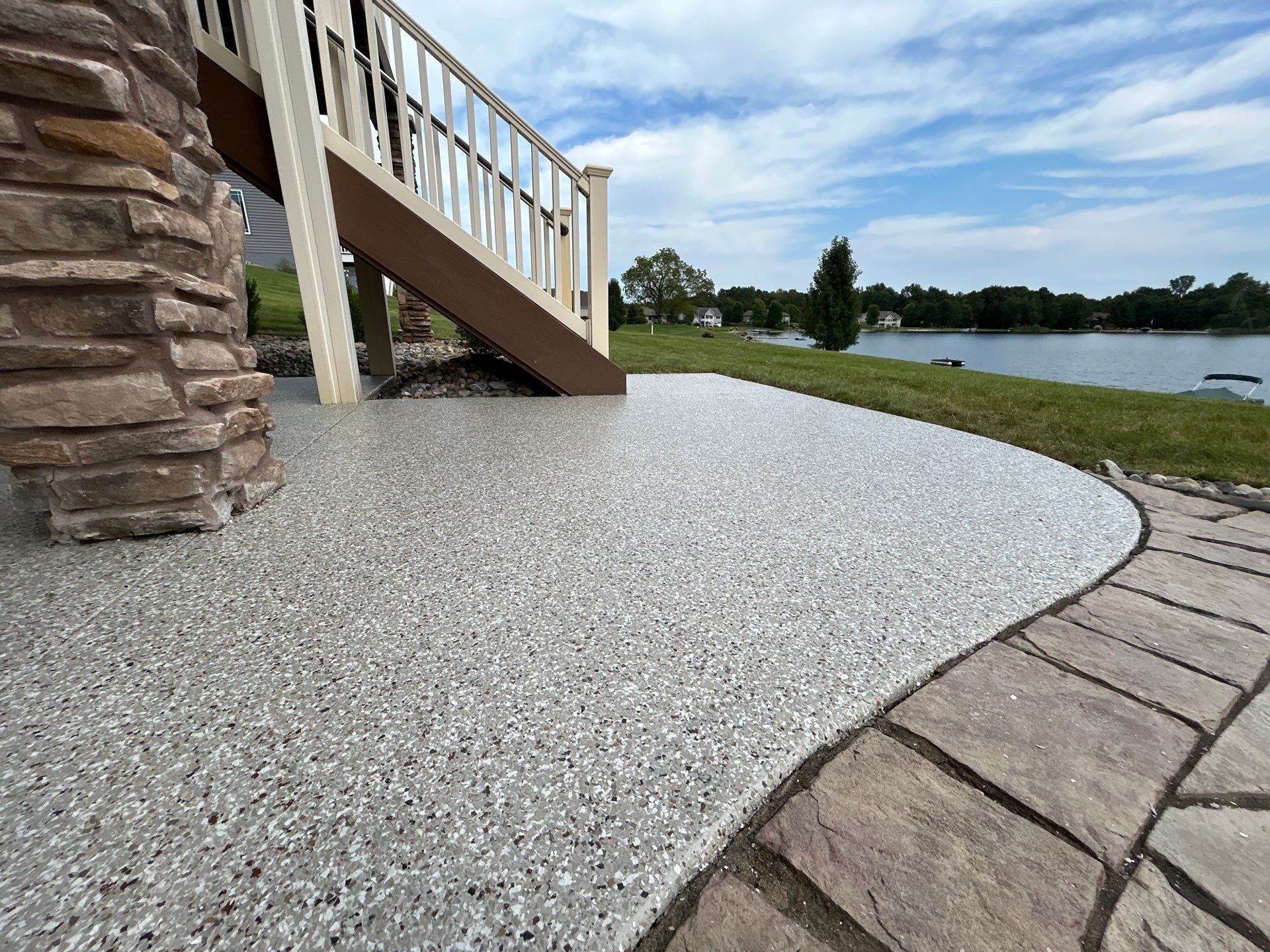
Concrete sealing is the protection system for every concrete and paver surface — driveway, patio, walkways, pool deck. It closes the pores that allow moisture, oil, and biological growth to penetrate, provides UV stability for decorative surfaces, stabilizes paver joints, and creates the barrier that makes contamination easier to clean before it bonds permanently.
Without sealing, concrete deteriorates progressively — biological growth establishes in open pores, oil bonds deeply with each heat cycle, mineral deposits accumulate with each irrigation event, and freeze-thaw cycling damages the pore structure that unsealed concrete absorbs moisture into.
How the Three Services Work Together
The interdependence of the three services is what makes a coordinated plan more effective than managing each service independently.
Pressure washing enables staining and sealing: Every staining project requires pressure washing as prep. Every sealing project requires pressure washing as prep. This means that whenever staining or sealing is due, pressure washing is also due — and coordinating all three in the appropriate sequence on the same service visit is more efficient than scheduling each separately.
Staining and sealing extend the interval between pressure washing cycles: Sealed and stained surfaces accumulate contamination more slowly than unprotected surfaces — biological growth can't root as deeply, oil can't penetrate as readily, organic deposits don't bond as permanently. This means that surfaces maintained on a combined pressure washing and treatment program need less frequent cleaning than unprotected surfaces — the protection provided by staining and sealing reduces the cleaning burden rather than adding to it.
Pressure washing quality determines staining and sealing longevity: The thoroughness of pressure washing prep directly determines how long subsequent staining and sealing last. Stain and sealer applied to properly cleaned surfaces penetrate and bond correctly and deliver their full intended service life. Stain and sealer applied to inadequately cleaned surfaces fail prematurely — and the failure is attributed to the product or the service when the actual cause was the prep that preceded it.
Building the Coordinated Maintenance Plan
For a typical DFW residential property with a wood fence and concrete driveway, patio, and walkways, here's what a complete coordinated maintenance plan looks like — with timing aligned to DFW's seasonal conditions for maximum efficiency.
Annual service — pressure washing:
Spring pressure washing — scheduled in late April or May after peak pollen season — addresses all concrete surfaces and the fence with biocidal pre-treatment for biological growth. This annual cleaning prevents biological growth from accumulating to the multi-season depth that makes it harder to address and that causes ongoing chemical damage to surfaces.
The spring pressure washing also creates the clean surface condition that staining and sealing assessments are based on — the water bead test on concrete and fence surfaces after cleaning reveals the actual sealer and stain condition rather than condition obscured by accumulated contamination.
Every two to three years — fence staining:
When the water bead test on fence surfaces after spring cleaning shows depleted protection — or when the fence is approaching two to three years since the last staining — professional staining is scheduled as part of the spring service or shortly after it.
Staining follows the spring cleaning by the drying period the wood needs — typically 24 to 48 hours in DFW spring conditions. Including staining in the spring service sequence is more efficient than scheduling it as a separate visit.
Every two to three years — concrete sealing:
When the water bead test on concrete surfaces after spring cleaning shows depleted protection, concrete sealing is scheduled in coordination with the same service visit as the fence staining.
The sequence: spring cleaning of all surfaces, drying period, fence staining and concrete sealing in the same service visit. This single visit addresses the full scope of protection renewal that both surface types need, with pressure washing prep done once for all surfaces rather than separately for each service.
The fall service — assessment and targeted treatment:
Fall provides the second assessment window — a less comprehensive service than spring but an important check on conditions that developed through summer and need attention before winter.
Fall pressure washing of concrete surfaces addresses the leaf tannin staining and summer biological growth before winter rain drives deposits deeper. Fence assessment using the water bead test identifies any sections that depleted faster than expected through summer and need targeted restaining before the fall staining window closes. Concrete sealing condition is assessed — for surfaces that depleted faster than expected through a high-UV summer, fall resealing provides winter freeze protection from fresh sealer.
The Five-Year Maintenance Calendar for a Typical DFW Property
Putting the coordinated plan into a multi-year calendar shows what the service rhythm looks like over time — and how the timing of staining and sealing cycles relative to annual pressure washing produces the coordinated service visits that make the plan efficient.
Year one — spring:Full spring pressure washing of all surfaces. Water bead test reveals concrete and fence both depleted from previous ownership or multi-year gap. Full staining and sealing scheduled as single coordinated follow-up visit after drying. Every surface is freshly protected.
Year one — fall:Light fall assessment. Concrete and fence protection holding from spring treatment. Pressure washing of concrete to address fall leaf deposits. No staining or sealing needed.
Year two — spring:Full spring pressure washing. Water bead test confirms protection still active on both surfaces. No staining or sealing needed. Maintenance cleaning captures the year's biological growth and deposits.
Year two — fall:Fall assessment and concrete pressure washing. Protection holding on both surfaces. South and west-facing fence sections showing earlier depletion — noted for assessment at year three spring.
Year three — spring:Full spring pressure washing. Water bead test confirms fence protection depleted on most sections — staining due. Concrete protection still active on lower-traffic areas, depleted on high-traffic turning zones near garage — targeted sealing of depleted sections scheduled.
Year three spring service: pressure washing, drying, fence staining and targeted concrete sealing — coordinated single visit.
Year three — fall:Fall assessment. Fresh staining and sealing from spring service — all protection holding well. Standard fall maintenance pressure washing.
Year four and five:Follows the same pattern — annual spring pressure washing with assessment, staining and full sealing renewal at the three-year point, fall maintenance cleaning. The cycle continues predictably and efficiently.
What the Coordinated Plan Costs Compared to Reactive Maintenance
The cost comparison between the coordinated maintenance plan and reactive maintenance — addressing each surface when it looks bad enough to act on — consistently favors the coordinated approach over any multi-year period.
Coordinated plan costs: Annual spring pressure washing. Staining and sealing every two to three years as a combined service. Fall maintenance cleaning. These are predictable, budgeted costs that don't produce surprises.
Reactive maintenance costs: Irregular pressure washing that happens when surfaces look obviously dirty — which by the time it's obvious means biological growth has been accumulating damage for a season or more. Staining and sealing that happens when surfaces show visible deterioration — which means the wood and concrete have already experienced the UV damage, moisture penetration, and biological acid attack that timely treatment would have prevented. More extensive prep work at each reactive service because more damage has accumulated between services. Higher per-service costs because the scope of each reactive service is greater than the scope of each coordinated service.
The reactive approach consistently produces higher total maintenance costs over any five or ten year period than the coordinated approach — because the accumulated damage between reactive services requires more treatment, and the deterioration that occurs without consistent protection requires more restoration than consistent maintenance would have required.
Single Contractor for the Complete Plan
The practical implementation of the coordinated plan is most efficient when a single contractor handles all three services — the integrated knowledge of every surface on the property, consistent quality standards across every service, and coordinated scheduling that aligns services correctly without the homeowner managing multiple contractors on separate schedules.
DFW Pressure Washing & Fence Staining LLC provides pressure washing, wood staining, concrete sealing, and fence installation throughout the Dallas-Fort Worth area — including Kennedale, Arlington, Mansfield, Fort Worth, Grand Prairie, and surrounding communities.
Every property we service has a maintenance history that informs each subsequent service — when each surface was last treated, what conditions were present at the last service, and when the next treatment cycle is approaching. This history allows proactive scheduling recommendations rather than waiting for the homeowner to call when something looks bad.

Want to get every exterior surface on your DFW property on a coordinated maintenance plan — with pressure washing, staining, and sealing timed and sequenced for maximum protection and minimum total cost? DFW Pressure Washing & Fence Staining LLC builds complete exterior maintenance programs for DFW homeowners that keep every surface protected year-round through a single coordinated service relationship.
Get Your Free Estimate → dfwpressurewashing.net/contact-us
DFW Pressure Washing & Fence Staining LLC


